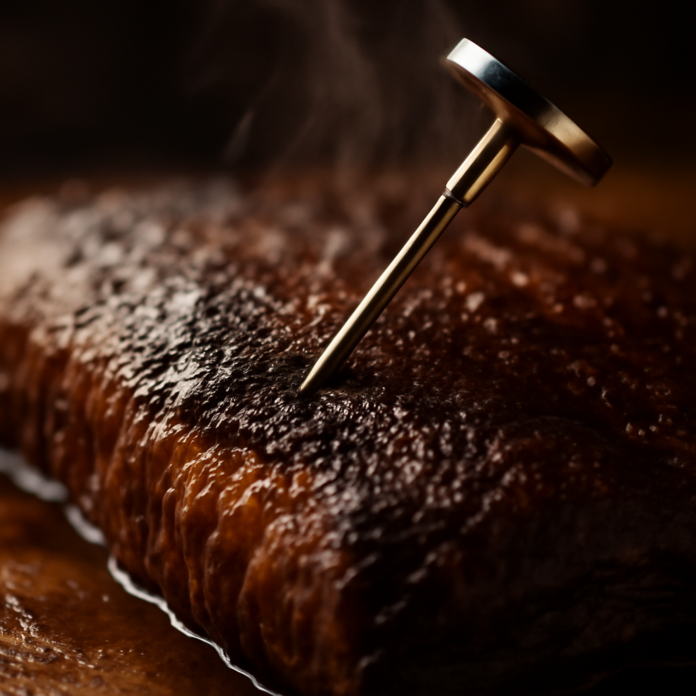
Use this safe internal temperature chart for smoked meat to cook flavorful barbecue that meets food safety standards. You’ll learn the danger zone, how to measure smoker and meat temps accurately, and target times and internal temperatures for beef, pork, poultry, and seafood.
Meat temperature health and safety basics
Safety in smoked meat comes from internal temperature, not how hot your smoker runs. Use a reliable food thermometer and base decisions on pathogen-killing temperatures. “Tender” and “safe” aren’t the same—many barbecue cuts go higher for texture, but they’re considered safe once they meet the minimum internal temperature and any required rest.
Baseline safe internal temperatures:
- Poultry (whole or parts): 165°F.
- Ground meats (beef, pork, poultry): 160°F.
- Whole-muscle beef, pork, lamb: 145°F, then rest at least 3 minutes.
- Fish and seafood: 145°F, or until opaque and flaky.
Rest times matter because heat equalizes and finishes the kill step; don’t skip them. Carryover heat can help reach the target, but only start the rest once the center hits the minimum. Insert the probe into the thickest part, avoiding bone and obvious fat pockets, for a true reading. For authoritative guidance, see Official safe cooking temperatures.
The danger zone: safe handling and holding temperatures
Understanding the danger zone is essential for barbecue food safety. Bacteria multiply quickly between 40°F and 140°F. Keep raw meat refrigerated until your smoker is fully preheated, and use clean hands, tools, and trays to prevent cross-contamination.
- Preheating and loading: Bring the pit to a steady 225–275°F before adding meat. This shortens time spent in the danger zone.
- Time limits: Don’t let perishable foods sit between 40°F and 140°F longer than 2 hours total (1 hour in hot weather).
- Hot holding: After cooking to a safe endpoint (see the safe internal temperature chart for smoked meat), hold at or above 140°F. Use a probe in the thickest part to confirm.
- Resting safely: Rest wrapped in a warm holding setup (insulated cooler or warming drawer) that keeps the core at or above 140°F. If you can’t hold it hot, slice and serve promptly.
- Cooling leftovers: Cool fast: portion large roasts, use shallow pans, and refrigerate promptly. Move from hot to below 40°F as quickly as practical; an ice bath speeds it up.
- Reheating: Reheat leftovers to 165°F quickly; avoid slow-warming appliances that linger in the danger zone.
How to accurately measure smoker and meat temperature
Accurate smoking relies on two numbers: the smoker’s air temperature (pit) and the meat’s internal temperature. Use a reliable digital system: a leave‑in probe clipped at grate level to read the pit, a second probe in the meat, and an instant‑read for quick spot checks near the end. Always compare readings to your safe internal temperature chart, not the dome thermometer.
Place the meat probe in the geometric center of the thickest part. Avoid bone, fatty seams, and the surface. For brisket, probe the thickest area of the flat and, if possible, the point as well. For pork shoulder, aim for the center away from the blade bone. For whole poultry, target the deepest part of the thigh without touching bone. For ribs, slide the tip between bones toward the thickest meat.
- Clip the pit probe to the cooking grate beside, not above, the food.
- Route probe cables through a grommet; keep wires off hot metal and flames.
- Minimize lid openings; watch trends on your thermometers instead.
- Verify accuracy with an ice bath and a gentle boil; adjust for altitude.
- Sanitize the probe tip between checks to avoid cross‑contamination.
- Expect a small carryover rise while resting; confirm the final temperature before slicing.
Beef: smoking times and internal temperatures
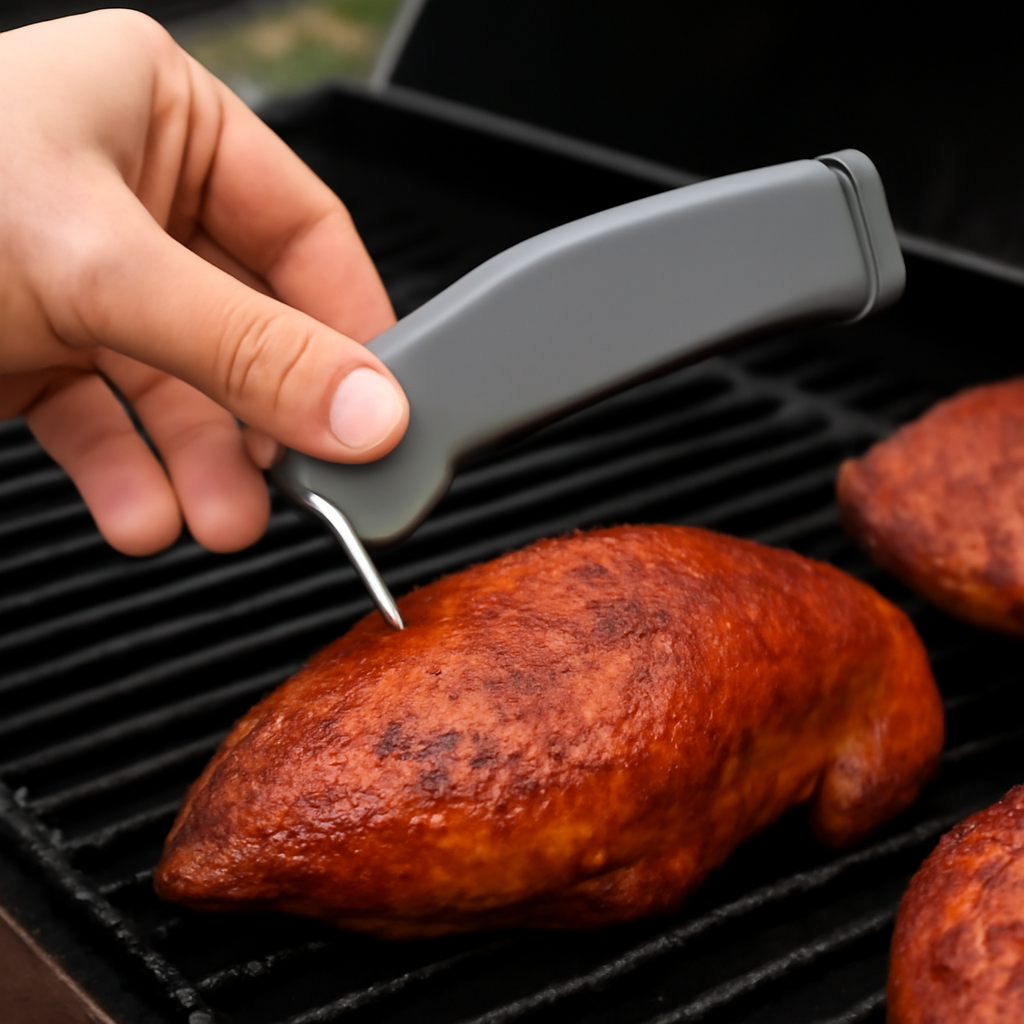
Beef shines with low-and-slow smoke, but doneness and safety ride on internal temperature, not the clock. Use this as your beef entry in a safe internal temperature chart for smoked meat. Times below assume a steady 225–275°F pit and are estimates; always cook to temperature and feel.
- Brisket (packer or flat): Plan 10–18 hours. Target about 200–205°F internal and stop when a probe slides in with little resistance. Rest well, wrapped, before slicing.
- Beef plate/short ribs: 6–10 hours. Cook until roughly 200–205°F and probe-tender between the bones for buttery texture.
- Chuck roast: 6–9 hours. Take to about 200–205°F for shreddable texture; slice a bit earlier for firmer slices.
- Tri-tip or similar roasts: Often smoked then seared. Pull around 130–135°F if aiming for medium-rare; for safety, official guidance sets 145°F with a rest. Usually 1½–3 hours before the sear.
- Ground beef (meatloaf, “fatties”): Go to 160°F throughout. Expect roughly 1½–3 hours depending on thickness.
Whole-muscle beef has a minimum of 145°F with a brief rest; ground beef 160°F. Expect a mid-cook stall on large cuts. Stable heat makes this easier; if you’re evaluating gear, consider choosing a reliable smoker.
Pork: smoking times and internal temperatures
When smoking pork, time gets you close; internal temperature and tenderness finish the job. Use this pork-focused safe internal temperature chart for smoked meat as a quick guide, then confirm with a reliable thermometer.
- Pork loin (roast) and chops: Target 145°F, then rest at least 3 minutes. At 225–250°F, a 2–3 lb loin typically runs 2–3 hours; thick chops often 45–90 minutes.
- Pork tenderloin: 145°F plus a 3-minute rest. Expect roughly 1–2 hours at 225–250°F.
- Pork shoulder/butt: Safe at 145°F, but for shreddable pulled pork aim 195–205°F and probe for butter‑like tenderness. Plan about 1.5–2 hours per pound at 225–250°F.
- Spare/St. Louis ribs: Cook until meat between bones reaches roughly 190–205°F and a probe slides in easily; 5–7 hours at 225–250°F is common.
- Baby back ribs: Similar doneness cues; often 4–6 hours at 225–250°F.
- Ground pork/sausage: 160°F in the center. Timing varies by diameter; many links take 1.5–2.5 hours at 225–250°F.
- Ham: If fully cooked (labeled “ready‑to‑eat”), warm to 140°F internal. Fresh ham should reach 145°F and rest 3 minutes; time depends on size.
Verify temps in multiple spots away from bone, and account for slight carryover after removing from the smoker.
Poultry: smoking times and internal temperatures
With poultry, food safety is nonnegotiable: the safe minimum internal temperature is 165°F (74°C) measured at the coolest spot. Times vary by bird size and pit temperature, so cook to temperature, not the clock. At a steady 225–275°F, expect roughly:
- Whole chicken: 3–5 hours; 165°F in deepest breast; thighs 175–185°F for tenderness.
- Spatchcocked chicken: 2–3.5 hours; same targets as above.
- Chicken thighs or drumsticks: 1.5–2.5 hours; 175–185°F in the thickest meat by the bone.
- Chicken wings: 1–2 hours; 175–185°F at the drumette’s thickest point.
- Turkey breast (bone-in or boneless): 2.5–4 hours; 165°F in the center.
- Whole turkey: 6–9+ hours; 165°F in breast, 175–185°F in thigh.
Insert your probe horizontally into the thickest meat without touching bone, and confirm in multiple spots. If you stuff a bird, the center of the stuffing must also reach 165°F; better yet, smoke dressing separately. Rest 10–15 minutes; for crisper skin, finish with a brief high-heat blast while keeping final temps at or above the targets.
Fish and seafood: smoking times and internal temperatures
Fish and seafood cook fast in smoke, so plan shorter cooks and precise doneness checks. For hot smoking, keep the pit around 180–225°F. For safety, finfish should reach a 145°F internal temperature measured in the thickest part. If you’re building a safe internal temperature chart for smoked meat and fish, use 145°F as the finfish benchmark.
- Finfish fillets/steaks (salmon, trout, cod, halibut): 30–90 minutes until 145°F; flesh opaque and flakes cleanly. Skin-on helps retain moisture; a brief brine can improve texture.
- Whole fish (trout, snapper, similar sizes): About 1–3 hours to 145°F in the thickest section near the backbone. Watch for even opaqueness to the bone.
- Shrimp and scallops: 20–45 minutes until just opaque and firm; no glassy centers. Overcooking turns them rubbery quickly.
- Lobster and crab (in shell): 45–90 minutes until meat is pearly, opaque, and set.
- Clams, mussels, oysters: 15–60 minutes until shells open; discard any that stay closed.
Some cooks prefer lower pull temperatures for certain fish textures; that’s a quality choice, not the food-safety guideline. Cold-smoking fish without precise curing and environmental control is a specialized process—stick to hot smoking for reliable safety at home.
Dealing with the barbecue stall
The stall is a natural plateau where internal temperature stops climbing—often around the mid-150s to upper-160s—as surface evaporation cools the meat. It can last for hours. Don’t chase it by constantly fiddling; treat it as part of the cook and manage it with intent.
- Ride it out: Hold a steady pit temperature and avoid opening the lid. Consistency shortens the stall more than guesswork does.
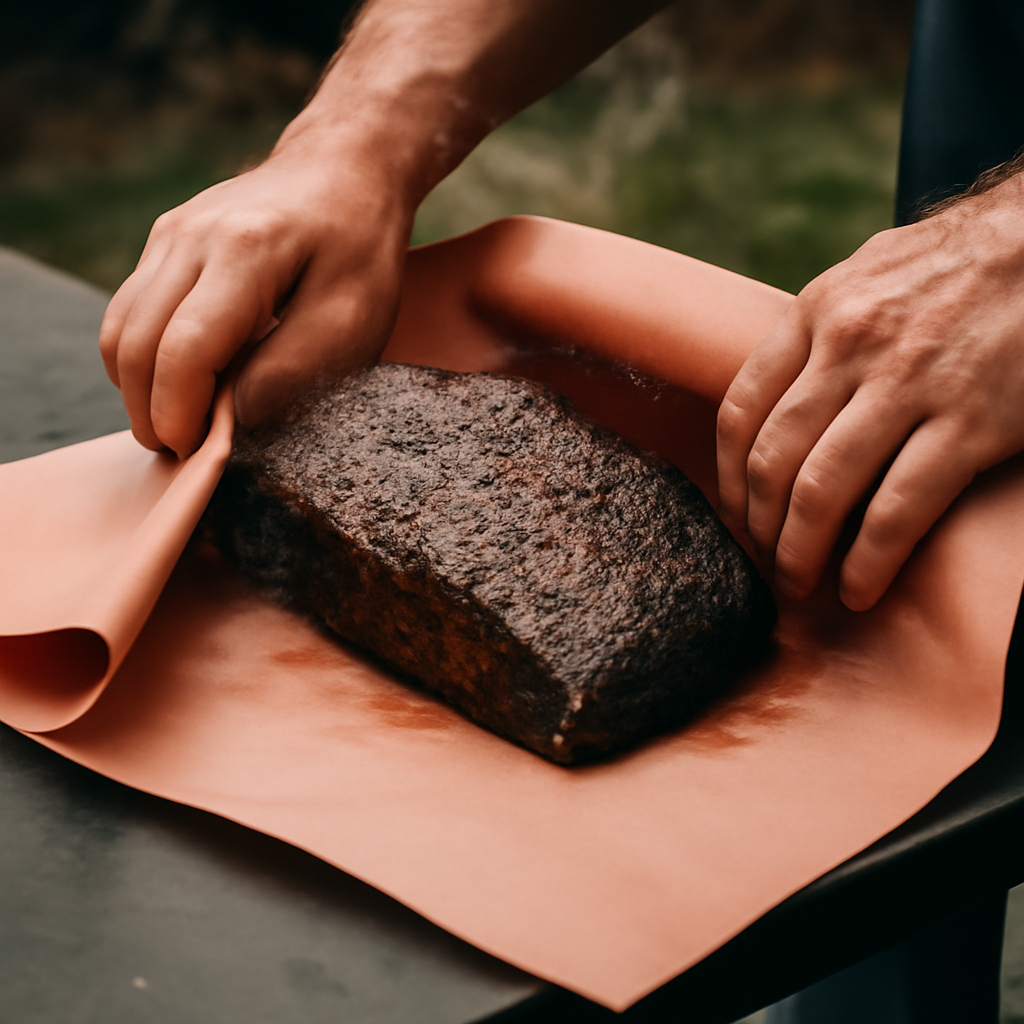
- Wrap (Texas crutch): When the bark is set and your probe shows the mid-150s to upper-160s, wrap tightly in unwaxed butcher paper or foil to reduce evaporative cooling and speed through.
- Use gentle humidity: A small water pan stabilizes heat. Light spritzing before wrapping can help, but don’t drench the bark.
- Nudge the pit temp: A modest increase can push past the plateau without drying the exterior. Avoid big jumps that toughen the bark.
- Verify probe placement: Aim for the thickest part, away from fat seams or bone, so you’re reading true internal temperature.
- Cook to outcomes, not the clock: Use your safe internal temperature chart for smoked meat to decide when you’re done, then rest wrapped to even out juices and tenderness.
Tips for managing a long smoke
Long smokes are won in the planning and protected by steady fire control. Before you light up, map a timeline, stock more fuel than you think you need, and keep your safe internal temperature chart for smoked meat handy so you’re never guessing about finish or hold targets.
- Stabilize first: Bring the cooker to a steady temp and wait for thin, blue smoke before adding meat.
- Fuel management: Add small, preheated splits or fully lit charcoal. Make tiny vent changes and avoid smoldering wood.
- Weather prep: Use a windbreak and place the smoker with the firebox away from gusts. Expect extra fuel in cold or windy conditions.
- Moisture control: A water pan helps stabilize pit temps and keeps bark from drying too fast. Spritz sparingly.
- Placement and rotation: Learn your cooker’s hot spots. Rotate or reposition large cuts to even out cooking.
- Alarms, not peeks: Use multi-probe alarms for pit and meat. Log times. Open the lid only with a purpose.
- Wrap and hold: If timing runs long, wrap once bark is set, then rest and hold in an insulated cooler above safe ranges.
- Have a bailout: If the fire turns fickle near the end, finish in a preheated oven.
With clear targets and careful measuring, you can smoke meat that stays tender and safe. Refer to the chart, mind the danger zone, and manage the stall with patience. Keep your smoker steady and your tools calibrated, and the results will be consistent from cook to cook.